
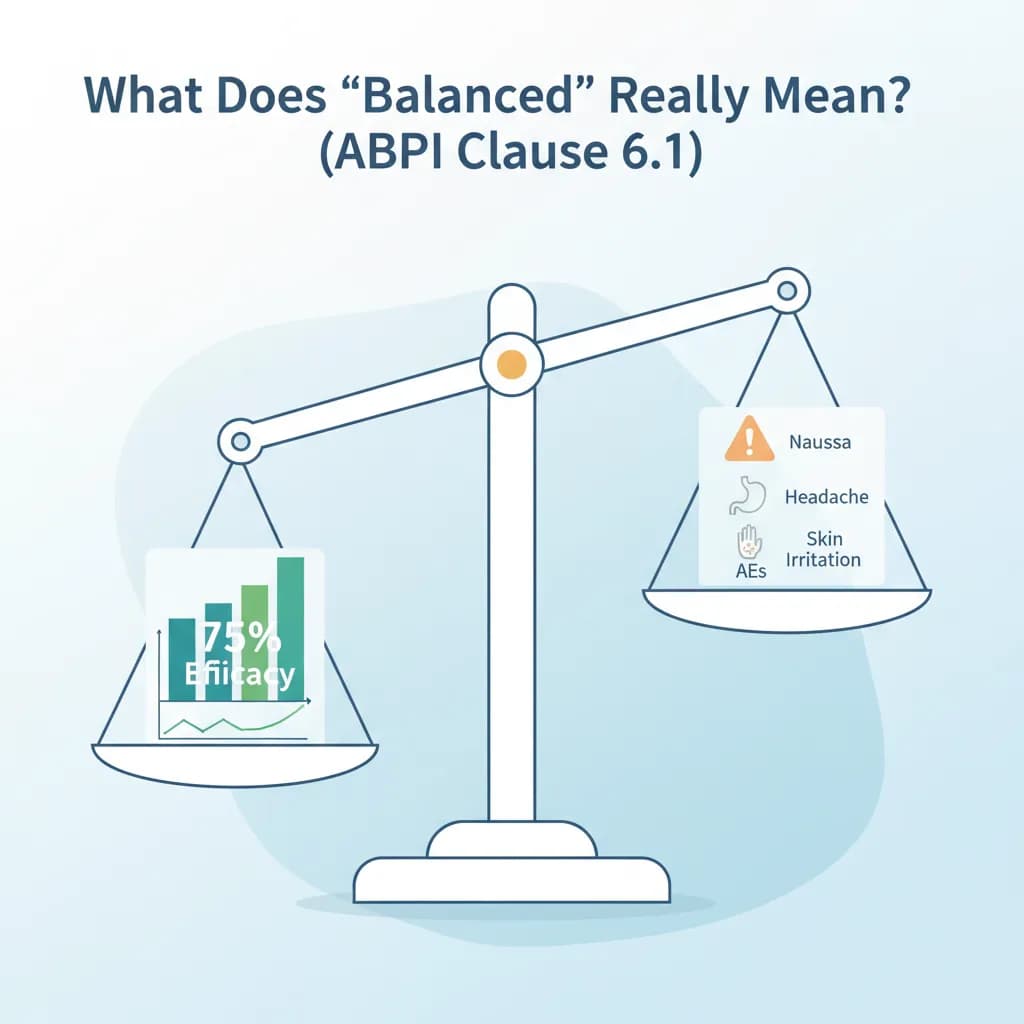


A brand manager surprised me when she asked me if the new ad was ‘balanced’. I think she said it with the hope that I’d just nod and move on. Instead, I had to pause — because in pharma, ‘balance’ isn’t a box-tick, it’s a fundamental that makes or breaks patient trust (and compliance). Especially under Clause 6.1, ‘balance’ turns out to be less about splitting the page down the middle, and more about context, truth, and proportion. Yet for all this talk, the term is so overused it’s almost lost meaning. Let’s pull it apart, see what the ABPI Code is really getting at, and finally put some teeth into this famous fuzzword.
1. Where ‘Balanced’ goes wrong: The phantom word of pharma promotion
Let’s be honest: in UK pharmaceutical marketing, “balanced” is the word we all reach for—signatories, marketers, medics—when we want to reassure ourselves (and the PMCPA) that our promotional claims are compliant. But what does “balanced” really mean under the ABPI Code of Practice? And why is it so endlessly overused?
In my experience, “balanced” is often treated like a magic stamp for compliance. We drop it into sign-off meetings, hoping it’ll smooth over any tricky conversations about risk, side effects, or limitations. But here’s the catch: everyone in the room has a slightly different idea of what “balance” actually looks like. For marketers, it might mean a single safety line at the bottom of a page packed with efficacy claims. For medical reviewers, it’s about context, proportionality, and ensuring that benefits and risks are both clearly presented.
Here’s a real-world example: I once reviewed a leavepiece where “balance” was supposedly achieved by tacking on a single, generic safety statement—after three pages of glowing efficacy data. Nobody blinked until review stage, when someone finally asked, “Is this really balanced?” That’s when the confusion set in. The truth is, over 50% of PMCPA cases citing imbalance (2022 data) involve non-contextual or tokenistic safety information. It’s a consistent grey area, and one that keeps tripping us up.
“Balance isn’t about symmetry — it’s about context.”
The problem is, the overuse of the “balanced” term can lead to complacency or box-ticking. We say it, we write it, but do we really deliver it? Marketers and medics often disagree on what constitutes genuine balance, and the PMCPA’s case summaries show this is a persistent source of challenge under the ABPI Code of Practice.
How imbalance happens in practice
Selective data: Highlighting only positive outcomes, with minimal mention of risks or limitations.
Non-contextual safety: Adding a safety line without relating it to the efficacy claims.
Visual imbalance: Using bold graphics for benefits, but burying risks in footnotes.
Practical Checklist for True Balance
Are risks and benefits given equal prominence?
Is safety information specific and contextual?
Could a reasonable HCP be misled by omission or emphasis?
Pharma’s love-hate relationship with “balanced” is clear: it’s easy to say, hard to pin down—and that’s exactly why we need to keep challenging ourselves on what it really means in every piece of promotional material.
2. Balance, ABPI-Style: What the code actually demands (and why it matters)
Let’s face it: “balanced” is probably the most overused—and misunderstood—word in UK pharma communications. We all talk about balanced claims and balanced materials, but when it comes to sign-off, the grey area looms large. So, what does “balanced” really mean under the ABPI Code of Practice—and why does it matter for ethical standards, patient safety, and appropriate prescribing?
Clause 6.1: The Heart of balance
Clause 6.1 is the cornerstone: promotional information must be “accurate, balanced, fair, objective....” But let’s unpack that. Accurate means factually correct. Fair means not misleading by omission or exaggeration. Balanced means presenting the totality of evidence—not just the good bits.
Balance = Truth + Context + Proportion
Balance isn’t just about mentioning a risk in tiny print or tacking on a safety statement at the end. It’s about:
Truth: Claims must reflect the real-world evidence, not cherry-picked positives.
Context: Benefits and risks must be presented together, in a way that’s meaningful for prescribers.
Proportion: No burying adverse events or exaggerating efficacy. Both sides get equal weight.
What Imbalance Looks Like in Practice
Highlighting efficacy without substantiating safety data.
Burying adverse events in footnotes or small print.
Using absolute terms like “well-tolerated” without context or evidence.
Making claims like “no new safety risks” but failing to cite the source—a classic patient safety pitfall.
Why It Matters:
The ABPI Code of Practice sets a higher bar than UK law. It’s about patient-centric communication, not just ticking compliance boxes. As the Code itself says:
"The ABPI Code aims to ensure patient benefit via ethical communication — it’s not about box-ticking compliance."
Imbalance can undermine patient safety, damage company reputation, and erode trust in the industry. No wonder Clause 6.1 is the most-cited provision in PMCPA cases—over 30% of all promotional material breaches.
Quick Reviewer Checklist
Are both benefits and risks clear and equally prominent?
Is safety data substantiated and sourced?
Are claims supported by the full body of evidence?
Would a prescriber get a fair, realistic picture?
3. Spotting imbalance in the wild: Practical (and painful) Pharma examples
Let’s get real about what “imbalance” looks like in pharmaceutical advertising examples. We all know the ABPI Code demands balanced claims and clear promotional material requirements, but in practice, imbalance creeps in—sometimes subtly, sometimes glaringly. Here’s what I see most often, and what every reviewer and signatory should be ready to catch.
Scenario 1: The 90% efficacy headline—But safety buried in footnote 8
Picture this: a glossy ad shouts “90% efficacy!” across the top, but the adverse event rates are tucked away in a tiny footnote. This isn’t just a design choice—it’s a classic case of out-of-context balance. The benefits are front and centre; the risks are hidden. According to PMCPA, 21% of 2023 Code breaches involved incomplete or misleading risk context. If data visuals don’t reflect safety, they’re just sales graphics in disguise.
Scenario 2: “No new risks seen”—But no SmPC reference
Another painful example: a claim like “No new risks seen in trials” appears, but there’s no citation from the Summary of Product Characteristics (SmPC). Without substantiation, the reader can’t verify the claim. The Code is clear: every claim must be backed by the SmPC or robust evidence. Anything less is a breach of patient information standards.
What reviewers should train their eyes to spot
Selective data: Only showing the positives, omitting negatives.
Missing comparators: The infamous “hanging comparison”—stating “better than X” without showing X’s data.
Un-attributed patient benefits: Quoting improvements without source or context.
Internal politics: The Tug-of-War
Let’s not ignore the elephant in the room: sometimes, balance is a casualty of internal debates. Marketers want impact; medics want accuracy. The result? Materials that lean too far one way, risking Code breaches.
Wild Card: Would you sign this off?
Imagine a new product launch where every headline claim is paired, right there, with a plain-English summary of risks. Would you sign it off—or hesitate? If you pause, ask yourself why. True balance means risks and benefits are equally visible, not buried or glossed over.
“If data visuals don’t reflect safety, they’re just sales graphics in disguise.”
4. The Balance checklist: A down-to-earth tool for Marketers and Medics
Let’s be honest: “balanced” is one of those words we all throw around in pharma, but when it comes to sign-off, it can feel maddeningly vague. That’s why I’m a big believer in practical tools—especially a mental checklist for balanced marketing. Embedding these checks into our daily workflow is the single best way to avoid those accidental slips into imbalance that can land us in regulatory hot water.
So, what does a balanced pharmaceutical communications mental checklist actually look like? Here’s the down-to-earth tool I use—built to align with the ABPI Code’s focus on substantiation, fair presentation, and regulatory compliance.
1️⃣ Have we given sufficient safety context for any efficacy statement?
If you’re highlighting a benefit, have you also made the relevant safety information clear? For example, if a headline shouts about a 70% response rate, is the side effect profile just as visible and accessible?2️⃣ Have we avoided absolute language ('best', ‘safe’, ‘no risk’)?
The ABPI Code is clear: words like “safe” or “no risk” are rarely justifiable. Even subtle superlatives can tip the balance. Double-check for these red-flag terms before sign-off.3️⃣ Would a reasonable HCP get the full, accurate picture of benefit vs risk from this content alone?
Imagine a busy healthcare professional reading your material in isolation. Would they walk away with a fair understanding, or is the risk information buried in the small print?Bonus: Try the ‘coffee test’.
Could you explain the content’s balance in plain English to a colleague at the next coffee break? If you’d struggle, the material probably needs work.
Most signatories I work with say that a promotional material mental checklist like this is the most useful tool for upskilling teams and embedding balance into everyday sign-off. As I often say in my ABPI Code mentorship sessions:
“Helping teams build that instinct for balance is what I focus on in my ABPI Code mentorship sessions — turning borderline grey zones into confident, compliant judgement.”
For extra practice, try reviewing sample copies with hidden imbalances as a team exercise. Spotting these in a safe setting builds real-world confidence and sharpens your compliance instincts.
Conclusion: From grey zone to 'Gold Standard' — Why Balance is a skill, not a slogan
After years of reviewing promotional materials and mentoring teams on the ABPI Code of Practice, I’ve seen “balance” used as a catch-all phrase—often invoked, rarely interrogated. But if we want to move from grey zone to gold standard in ethical pharmaceutical communications, we need to treat balance as a living skill, not a static slogan.
True balance isn’t about ticking a box or giving equal space to benefits and risks. As I often remind colleagues,
Balance under the ABPI Code means truth, context, and proportion — not just box-ticking or equal column inches.
When we get it right, we enable appropriate prescribing by communicating fairly, honestly, and with the patient’s best interests at heart. This is the foundation of both patient safety and professional credibility.
But here’s the reality: building real expertise in balanced claims takes more than reading the Code. It’s a journey—one that’s shaped by mentorship, ongoing training, and a genuine curiosity about how our words land in the real world. Every signatory and marketer should ask themselves: Where do my materials stand on truth, context, and proportion? Am I presenting data in a way that supports ethical, informed decisions, or am I unconsciously tipping the scales?
If balance feels instinctive to you, that’s a sign you’re on the right track. But if it feels awkward or forced, it’s time to dig deeper. Seek feedback, ask questions, and don’t be afraid to challenge your own assumptions. This is how good practice becomes gold standard—and how we collectively raise the bar for ethical pharmaceutical communications.
Balance is not a one-off achievement; it adapts and grows with experience, teamwork, and a willingness to learn. If you’re keen to sharpen your team’s instinct for balance and move beyond compliance to true credibility, I invite you to join my ABPI Code mentorship sessions. Together, we can turn the foggiest grey areas into clear, patient-centred gold standards.
In the end, balance matters most because it safeguards patients and strengthens our professional reputation. Let’s treat it as the skill it is—dynamic, nuanced, and absolutely essential to everything we do under the ABPI Code of Practice.